Last updated June 21, 2026
The Complete Guide to Garage Door in San Antonio
San Antonio averages more than 220 sunny days a year, and that relentless UV exposure degrades door seals and panel finishes 30–40% faster than the national averages cited on most product spec sheets — a fact most installers won’t volunteer at the point of sale. Add caliche-heavy soil that shifts foundations and frames, summer temperatures that regularly hit 100°F, and a housing stock ranging from 1970s ranch homes in Helotes to new Hill Country builds along Stone Oak Parkway, and you’ve got a city where generic garage door advice fails homeowners fast. This guide is built entirely around San Antonio’s specific conditions — so every decision you make about your door is the right one for where you actually live.
Quick Answer
A garage door in San Antonio needs to be selected, installed, and maintained with South Texas heat cycles, clay-heavy soil movement, and high UV exposure in mind — factors that directly affect which materials last, which openers perform, and what repairs actually cost in this market. Service calls in San Antonio typically start around $85, while full installations range from roughly $900 to $3,200 depending on door type, material, and opener system. Getting those decisions right from the start is the difference between a door that lasts 20 years and one that warps, binds, or fails within two summers.
Table of Contents
- How San Antonio’s Climate and Soil Affect Your Garage Door
- Which Door Materials Actually Hold Up in South Texas
- Full Cost Breakdown for San Antonio Homeowners
- Brand Landscape and Local Parts Availability in San Antonio
- Matching Your Opener System to Your San Antonio Home
- A Maintenance Schedule Built for San Antonio Conditions
- Common Mistakes to Avoid
- When to Call a Professional
- Frequently Asked Questions
- The Bottom Line
How San Antonio’s Climate and Soil Affect Your Garage Door
Most of what you’ll read about garage door maintenance was written for a temperate, four-season climate — not for a city where soil expands and contracts with every dry spell and flash flood. San Antonio sits on a geological layer rich in expansive clay and caliche, and that ground movement is one of the most underdiagnosed causes of garage door problems in this area. When the soil beneath your slab shifts even a quarter of an inch, door frames can rack out of square, causing the door to bind, gap at the bottom seal, or travel unevenly on its tracks. We see this consistently in older neighborhoods like Alamo Heights and in newer subdivisions built over raw Hill Country terrain where the soil hasn’t fully settled.
Here’s why this matters for repairs: frame misalignment caused by soil movement produces symptoms that look almost identical to a broken spring or a failing cable — the door won’t lift smoothly, it strains the opener, and it may sit crooked in the opening. If a technician replaces the springs without checking the frame geometry first, the root cause is still there and the new springs wear out prematurely. Before any spring or cable repair, the frame should be checked for square.
On top of soil movement, San Antonio’s heat creates its own set of problems. Lubricants rated for standard temperatures can thin out and migrate away from bearings above 95°F — which means a door lubricated in April may be running dry by July. UV radiation at South Texas latitudes breaks down vinyl and painted steel finishes at an accelerated rate, and rubber bottom seals typically need replacement every 2–3 years here versus the 4–5 years you’d see in a cooler climate.
Which Door Materials Actually Hold Up in South Texas
Walk through any big-box showroom and you’ll see beautiful wood doors and wide-profile composite panels that look stunning under fluorescent lights. Here’s the honest picture of how those materials perform in San Antonio specifically.
Steel (24-gauge or heavier)
This is the workhorse material for San Antonio homes, and for good reason. Heavy-gauge steel — 24-gauge or thicker — handles thermal expansion and contraction without warping, resists UV degradation better than wood or vinyl when properly painted, and holds up to the occasional hail event that rolls through Bexar County in spring. Thinner 28-gauge steel dents more easily and can develop rust at panel seams within a few years when exposed to the humidity that follows our monsoon-season storms in July and August. If you’re buying steel, invest in the heavier gauge — the price difference is usually $100–$200 on a standard two-car door, and it pays back in longevity.
Wood and Wood Composite
Real wood doors require serious commitment in this climate. They need repainting or resealing every 1–2 years to prevent the panel joints from absorbing moisture during humid stretches and then cracking during dry spells. In our experience, homeowners in stone-facade homes near Shavano Park or the Dominion who want the aesthetic of wood are better served by a high-density composite overlay on a steel core — you get the visual warmth without the maintenance burden.
Aluminum and Glass
Modern aluminum-framed glass doors are growing in popularity in newer builds along the 1604 corridor and in contemporary remodels near Southtown. They perform well thermally when fitted with insulated glass panels, but bare aluminum frames conduct heat aggressively — a non-insulated aluminum door can make an attached garage significantly hotter in July, which strains the opener motor and raises cooling costs if the garage is conditioned space.
Insulation Value in San Antonio
A door with an R-value of 12 or higher makes a measurable difference in an attached garage during Texas summers. It’s not just about interior comfort — a cooler garage means your opener motor runs at lower temperatures, extending its lifespan by several years.
Full Cost Breakdown for San Antonio Homeowners
National pricing guides are almost useless for San Antonio because they don’t account for local labor rates, regional material availability, or the specific repair patterns driven by South Texas conditions. Here’s a realistic cost range for the most common services in this market.
| Service | Typical San Antonio Price Range |
|---|---|
| Service call / diagnostic | $85 – $125 |
| Spring replacement (torsion, single) | $180 – $280 |
| Spring replacement (torsion, pair) | $240 – $380 |
| Cable replacement (per cable) | $95 – $165 |
| Roller replacement (full set) | $120 – $200 |
| Panel replacement (single panel) | $200 – $500 |
| Opener replacement (standard belt/chain drive) | $280 – $520 installed |
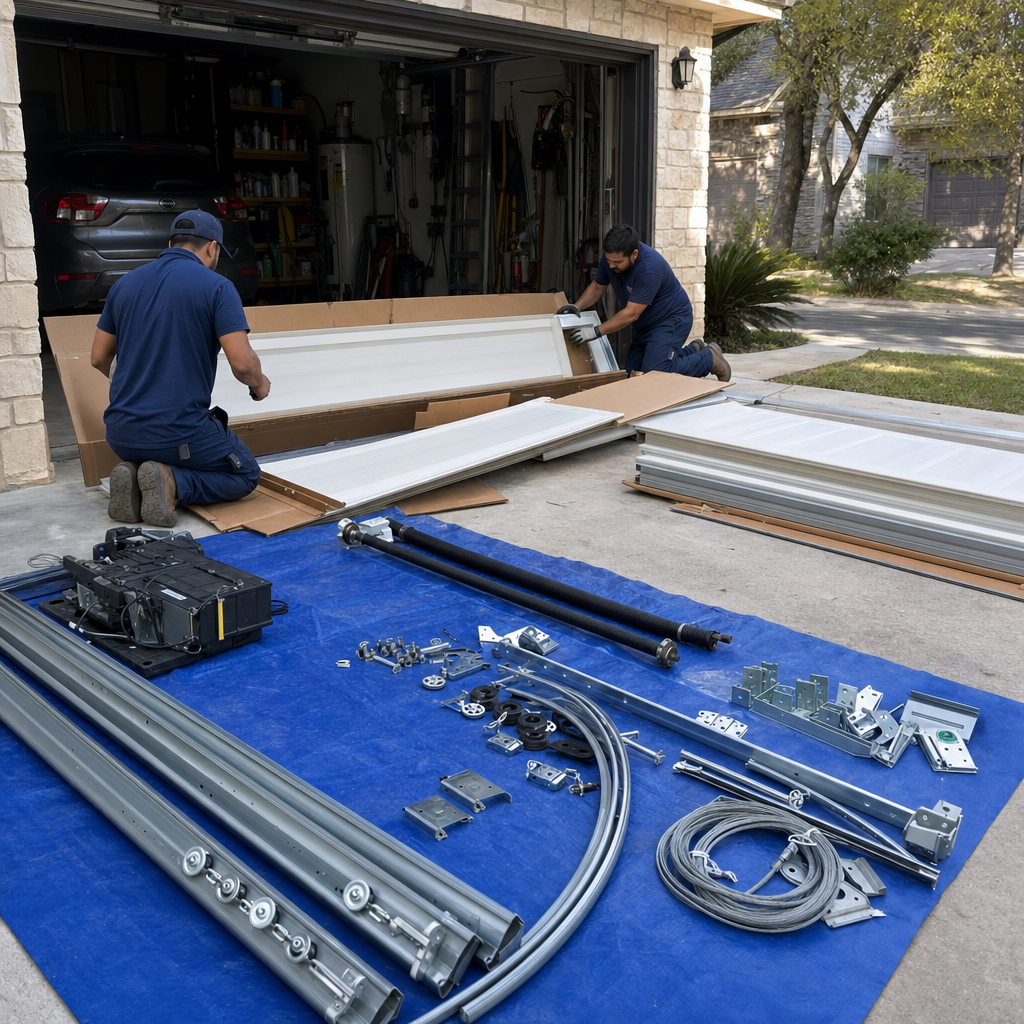
| New door installation (single car, steel) | $900 – $1,600 |
| New door installation (double car, insulated steel) | $1,400 – $2,400 |
| Full door + opener system (double car) | $1,800 – $3,200 |
A few notes on where prices land within those ranges: emergency service after hours will typically add $50–$100 to any job. Older homes in Lackland City or along the Culebra Road corridor sometimes have non-standard rough opening sizes from original construction, which can add 15–20% to installation labor because framing modifications are needed. Always get a written line-item estimate before any work begins — a reputable technician will give you one before touching the door.
Brand Landscape and Local Parts Availability in San Antonio
One question San Antonio homeowners rarely think to ask is whether parts for their door brand are actually available locally when something breaks. The answer matters when your garage door is stuck open at 11 PM on a Thursday.
Brands with Strong Local Parts Presence
- LiftMaster and Chamberlain: Both are owned by the same parent company and share a wide parts ecosystem. Springs, cables, logic boards, and remotes for LiftMaster and Chamberlain openers are stocked by multiple distributors in the San Antonio metro, meaning same-day or next-morning parts sourcing is realistic.
- Clopay: The most widely distributed residential door brand in the country, Clopay panels and hardware are accessible through regional distributors without extended lead times in most cases.
- Amarr: Amarr has strong regional distribution through Texas and parts are generally available within one to two business days locally.
- Wayne Dalton: Solid availability for standard hardware. Specialty torsion spring systems that are unique to Wayne Dalton (their TorqueMaster design) can occasionally require a short wait, so it’s worth knowing your model before calling.
Brands That May Require Shipped Components
- Raynor: Raynor makes an excellent door, but it’s a smaller brand with a thinner local distribution footprint in San Antonio. Specialty panel replacements may require shipping, which adds 3–7 days to a repair timeline.
- Craftsman (older models): Craftsman openers from the 1990s and early 2000s often need components that require online ordering. Newer Craftsman units (manufactured after the brand transition to newer production) have better parts availability.
- Genie: Genie openers have reasonable local availability for current models, but logic boards for discontinued units can be harder to source quickly in the San Antonio market.
At Express Gate Repair Services, Kevin Lopez carries stock for the most common failure parts across all eight brands — LiftMaster, Chamberlain, Genie, Clopay, Amarr, Wayne Dalton, Craftsman, and Raynor — specifically to avoid the “we’ll have to order that” answer that leaves a homeowner stranded.
Matching Your Opener System to Your San Antonio Home
Choosing an opener isn’t a one-size-fits-all decision in San Antonio. The right system depends on your garage layout, neighborhood context, and how the door will actually be used day-to-day.
Drive Type
- Belt drive: The quietest option — important in homes where the master bedroom sits above or adjacent to the garage, which is common in many Alamo Ranch and Stone Oak floor plans. Belt drives are our first recommendation for attached two-car garages in newer builds.
- Chain drive: Louder but highly durable and a lower entry cost. Works well for detached garages where noise isn’t an issue — older Alamo Heights properties with separate garage structures, for example.
- Direct drive / jackshaft: Mounts to the wall beside the door rather than overhead, which is valuable in garages with low ceilings or when the homeowner wants to use the full ceiling height for storage. We see demand for these in older 1970s-era homes near the Medical Center where ceiling clearance is tight.
Wind Load and Weather Considerations Near the Airport
Properties near San Antonio International Airport and in unincorporated areas of Bexar County that sit in open terrain can experience stronger straight-line winds during spring storm systems than neighborhoods buffered by dense tree cover. For these homes, a door rated to meet Texas windload requirements (and an opener with a sufficiently rated horsepower for the door weight) is not an overspecification — it’s a practical choice. A 1/2 HP opener running an oversized insulated steel door in a high-wind exposure zone will wear its drive mechanism out years ahead of schedule.
Smart Opener Features
LiftMaster’s myQ platform and Chamberlain’s connected openers allow real-time status monitoring and remote operation from a smartphone. In San Antonio’s summer heat, this is genuinely useful — you can confirm the garage door is closed without walking out to a 110°F garage interior. If you’re upgrading an opener, smart connectivity is worth the modest premium, especially with school-age kids who may forget to close the door during after-school routines.
For a detailed look at opener selection and installation options in the area, see our Garage Door Opener in Balcones Heights page, which covers specific model comparisons and installation considerations for that part of the San Antonio metro.
A Maintenance Schedule Built for San Antonio Conditions
A standard maintenance schedule doesn’t account for San Antonio’s climate reality. This one does.
- March (pre-summer prep): Lubricate all torsion spring coils, roller stems, and hinges with a high-temperature synthetic lubricant rated to 400°F or higher — standard white lithium grease begins migrating off bearing surfaces above 200°F, which happens inside a dark South Texas garage by May. Inspect the bottom seal and side weatherstripping for cracking from the previous summer’s UV exposure.
- May (heat-season check): Test the door’s balance by disconnecting the opener and lifting the door manually to waist height. A properly balanced door should hold its position; if it drops or rockets up, the spring tension is off. This test takes two minutes and tells you whether you’re heading into summer with springs that are about to fail under the added strain of heat-expanded hardware.
- July–August (monsoon-season inspection): San Antonio’s monsoon window brings humidity spikes that accelerate rust at cable ends, drum hardware, and any exposed hardware on older steel doors. After a heavy rain event, visually inspect cables and drums for surface rust and check that the track mounting bolts are tight — expansion and contraction cycles can slowly back out fasteners.
- October (post-summer assessment): After the heat breaks, check panel finish for UV chalking and touch up any bare metal or chipped paint before winter moisture sets in. Inspect torsion spring winding cones for visible cracks — springs that have been working hard all summer through temperature extremes are more likely to fracture in the first cold snap of fall when metal contracts sharply.
- January (annual hardware audit): Replace any roller that shows a flat spot, wobble, or nylon wear. Check that all track sections are properly aligned and that the lag bolts securing the track to the header are seated in solid wood — not in dried-out or crumbling drywall anchors, which is a common issue in San Antonio homes built in the 1980s and 1990s.
Common Mistakes to Avoid
- Replacing springs without checking the frame for square first. In San Antonio, soil movement is a root cause of door binding that mimics spring failure. Replacing the springs without measuring frame geometry means you’re treating the symptom, not the problem — and your new springs will wear out fast.
- Using standard white lithium grease as a garage door lubricant in summer. It’s fine in temperate climates but goes fluid in a San Antonio garage by June and drips off the hardware. Use a high-temperature synthetic lubricant rated for at least 350°F — the difference in longevity is measurable.
- Choosing a door based on showroom aesthetics without verifying the gauge. A lot of entry-level steel doors sold in the San Antonio market are 28-gauge, which looks identical to 24-gauge on a spec sheet until you know what to look for. Ask specifically — or have a technician confirm the gauge before installation.
- Ignoring the bottom seal until the door won’t seal at all. San Antonio’s UV exposure degrades rubber seals faster than most product specs suggest. A cracked seal lets humidity, insects, and heat-soaked air into the garage and forces the opener to work against unequal pressure. Replacing it every 2–3 years is maintenance, not a repair.
- Buying a 1/2 HP opener for a heavy insulated double door. An undersized opener labors on every cycle, especially in summer when the door hardware is at its most thermally expanded. For a full insulated double door in San Antonio, a 3/4 HP or higher-rated unit isn’t an upgrade — it’s the right specification.
- DIY spring replacement without proper tools. Torsion springs store enormous mechanical energy — enough to cause serious injury if a winding bar slips. This is not a task for improvised tools or YouTube confidence. Every year, we get calls in San Antonio from homeowners who’ve attempted it and created a worse problem than the one they started with.
- Skipping permits on a new installation in Bexar County when required. Some San Antonio neighborhoods and suburban municipalities within Bexar County require a permit for full garage door replacements involving structural header work. Skipping it can create title issues when you sell. When in doubt, ask your installer to confirm whether a permit is needed for your specific address before the job starts.
When to Call a Professional
Some tasks are genuinely homeowner-friendly: wiping down tracks, checking the door’s balance, replacing a remote battery. Others carry real injury risk or can turn a $200 repair into a $1,200 one if done wrong. Call a professional when:
- A torsion or extension spring is broken, visibly separated, or you hear a loud bang from the garage — this is a spring fracture and the door should not be operated.
- A cable has snapped or jumped off its drum — the door is under uneven tension and can fall.
- The door tracks are visibly bent, separated from the wall, or the door is scraping along one side.
- The opener runs but the door doesn’t move, or it reverses immediately after starting to close.
- The door is binding or won’t sit square in the frame after a heavy rain event or dry spell — this may indicate frame movement from soil shifting.
- You’re installing a new door or opener in a detached or older garage where the header, framing, or electrical may need to be assessed before work begins.
Express Gate Repair Services San Antonio offers free estimates across San Antonio. If you’re not sure whether you’re looking at a repair or a replacement, call us first at (830) 521-5767 — Kevin Lopez will give you a straight answer without turning it into an unnecessary sales conversation.
Frequently Asked Questions
How much does garage door repair cost in San Antonio?
Most garage door repairs in San Antonio fall between $85 and $380, depending on what’s broken. A service call or diagnostic typically starts at $85–$125. Spring replacement — the most common repair — runs $180–$280 for a single torsion spring and $240–$380 for a pair. Prices at the higher end of any range usually reflect after-hours emergency calls or older homes with non-standard hardware. Call (830) 521-5767 for a free estimate on your specific situation.
Can you fix my garage door the same day in San Antonio?
For the most common repairs — broken springs, snapped cables, roller replacement, opener faults — same-day service is typically possible when parts are in stock, which they usually are for major brands like LiftMaster, Clopay, and Amarr. Emergency service is available for urgent situations where waiting until the next business day isn’t an option. Call (830) 521-5767 to confirm availability for your repair.
Why does my garage door in San Antonio bind or stick only in summer?
Heat causes metal tracks and door hardware to expand, which tightens clearances that were fine in cooler months. If the binding appears only above 95°F, the track spacing likely needs minor adjustment for thermal expansion — a common and inexpensive fix. However, if the door also shows a gap at one corner of the frame, soil movement may have racked the opening slightly, which is a separate issue we see regularly in San Antonio homes built on expansive clay soil. A proper diagnosis tells you which it is before you spend money on the wrong fix.
Is it cheaper to repair or replace a garage door in San Antonio?
If the door structure — panels, frame attachment, and bottom section — is in sound condition, repairing individual components almost always costs less than full replacement. Replacement makes more sense when: multiple panels are damaged beyond individual replacement cost, the door is older than 20 years and hardware is failing system-wide, or the current door has no insulation and energy cost is a concern. In San Antonio’s summers, upgrading to an insulated replacement door can reduce garage interior temperatures by 20–25°F, which affects both comfort and opener longevity. Call (830) 521-5767 for an honest repair-vs-replace assessment at no charge.
Which garage door brands are best for San Antonio homes?
For San Antonio’s heat and UV conditions, Clopay’s Canyon Ridge and Coachman lines and Amarr’s Heritage series are well-regarded for finish durability on steel and composite doors. LiftMaster and Chamberlain openers have the strongest local parts availability in the San Antonio market, which matters for repair turnaround. Wayne Dalton offers solid mid-range options with good regional distribution. The “best” brand ultimately depends on your aesthetic preference, budget, and the specific insulation and gauge specs you need — which is a conversation worth having before you buy.
Do I need a permit for a new garage door in San Antonio?
For a straight door-for-door replacement with no structural or electrical changes, a permit is typically not required within the City of San Antonio limits. However, if the installation involves modifying the header opening, adding a new electrical circuit for the opener, or if you’re in a municipality within Bexar County that has its own permitting requirements (such as Helotes, Converse, or Universal City), permit requirements may apply. Always confirm with your installer before work begins — Express Gate Repair Services will let you know upfront what’s required for your address.
The Bottom Line
A garage door in San Antonio faces conditions that most generic guides simply don’t address: clay soil that shifts frames, summer heat that destroys lubricants and strains motors, UV exposure that degrades finishes faster than product specs suggest, and a housing stock that spans five decades of construction standards. Getting it right means choosing materials rated for South Texas heat cycles, matching your opener to your door’s actual weight and your home’s layout, maintaining the system on a schedule calibrated to this climate, and knowing the difference between a true component failure and a frame alignment problem caused by the soil beneath your slab. Make those distinctions, and your garage door will work reliably for two decades. Skip them, and you’ll be replacing components on a two-year cycle. For installations in the northwest part of the metro, see our pages on Garage Door Repair in Balcones Heights and Garage Door Installation in Balcones Heights for neighborhood-specific guidance.
Ready to Talk About Your Door?
If something in this guide sounds like your situation — a door that binds in summer, springs that have been working hard for years, or an opener that’s struggling with an undersized motor — Kevin Lopez handles every job personally and will tell you exactly what’s going on before any work begins. Express Gate Repair Services San Antonio has earned a 4.9-star rating across 26 verified reviews by giving homeowners a straight diagnosis and a right-the-first-time repair, not a quick patch that brings them back in six months. Call (830) 521-5767 for a free estimate — no pressure, no upsell, just a 16-year veteran who knows San Antonio doors.
Written by Kevin Lopez, Owner & Lead Technician at Express Gate Repair Services San Antonio, serving San Antonio since 2010.