Last updated June 21, 2026
Garage Door Repair Maintenance Checklist for San Antonio Homeowners
Here’s something most garage door guides won’t tell you: the service intervals printed in your owner’s manual were written for a national average climate that doesn’t exist in San Antonio. When summer temperatures regularly push past 100°F and the air carries enough humidity to rust bare steel overnight, the standard “lubricate once a year” recommendation becomes a recipe for a broken spring on a Sunday evening in August. After 16 years of diagnosing garage door failures across San Antonio — from Stone Oak to Southside and every neighborhood in between — Kevin Lopez has seen the same preventable breakdowns repeat themselves, season after season, almost always tracing back to maintenance advice that wasn’t calibrated for this city. This guide fixes that.
Quick Answer
A complete garage door maintenance checklist for San Antonio homeowners should cover lubrication, hardware tightening, spring and cable inspection, auto-reverse safety testing, bottom seal checks, and opener diagnostics — performed on a schedule adjusted for South Texas heat and humidity, not the national four-season template. In San Antonio’s climate, lubrication intervals should be shortened to every four months (not annually), grease products must be rated to hold viscosity above 95°F, and pest inspections for wasp nests and rodent wiring damage should be added as standard checklist items. Most breakdowns we see on Express Gate Repair Services San Antonio home calls are preventable with this adjusted routine.
Table of Contents
- Why San Antonio’s Climate Changes Everything About Maintenance Timing
- Climate-Adjusted Lubrication: What to Use and When
- Hardware Inspection: Springs, Cables, Rollers, and Tracks
- How to Test Your Auto-Reverse Safety System
- Bottom Seal and Weatherstripping in a San Antonio Heat Cycle
- The Checklist Items Nobody Talks About: Wasps, Rodents, and Low-Voltage Wiring
- Opener Health Check: LiftMaster, Genie, Chamberlain, and Beyond
- Month-by-Month Maintenance Schedule for San Antonio
- Common Mistakes to Avoid
- When to Call a Professional
- Frequently Asked Questions
- The Bottom Line
Why San Antonio’s Climate Changes Everything About Maintenance Timing
The national garage door maintenance guidelines most manufacturers publish assume a climate with cold winters, mild summers, and moderate humidity — none of which describes San Antonio. We operate in USDA Hardiness Zone 9a, with summer highs that routinely hit 98–104°F from June through September, humidity that spikes after afternoon storms, and winters mild enough that steel hardware never fully cold-contracts the way it does in northern states. That combination creates three specific maintenance problems that a generic checklist simply doesn’t address.
Heat accelerates lubricant breakdown. A standard white lithium grease has a dropping point (the temperature at which it stops behaving as a grease) around 370°F — which sounds safe until you consider that a dark metal garage door track sitting in direct south-facing Texas sun can reach surface temperatures of 140–160°F on a July afternoon. At those temperatures, lighter-grade greases thin out, migrate off the torsion spring coils, and pool at the bottom of the spring tube. The spring is now dry where it bends most, and you’ve got a failure in progress.
Humidity creates rust on a shorter timeline. In neighborhoods like Converse, Live Oak, and the East Side of San Antonio — where overnight humidity after summer thunderstorms can hit 90% — bare steel cable strands and torsion spring coils begin showing surface rust within a single off-season if left unlubricated. That rust isn’t cosmetic: it creates micro-pits on cable strands that become stress fracture points under load.
The dry-to-wet swing warps rubber and plastic parts. San Antonio’s cycle of dry spells followed by heavy rain events puts repeated stress on bottom seals, weatherstripping, and the nylon rollers that most mid-range doors from Clopay, Amarr, and Wayne Dalton ship with. Those parts expand and contract faster here than in a more stable climate, and they show wear 18–24 months sooner than the manufacturer’s projected lifespan.
Climate-Adjusted Lubrication: What to Use and When
The lubricant question is where San Antonio homeowners get the most conflicting advice, and most of that advice is wrong for this market. Here’s what 16 years of field work in this city has taught us about what actually stays on the metal.
What to Use
- Torsion springs and extension springs: Use a silicone-based garage door spray or a high-temp lithium grease rated to at least 300°F dropping point. Products labeled specifically for garage door springs — not general-purpose WD-40 or 3-in-1 oil — hold up through a San Antonio summer. WD-40 in particular evaporates quickly in heat and leaves springs dry within weeks.
- Hinges and rollers: A thin coat of silicone spray works well on nylon rollers. For steel roller bearings, a light machine oil or white lithium grease applied sparingly to the bearing housing (not the roller stem) is the right call.
- Tracks: Do not lubricate the inside face of the tracks. The rollers ride in the tracks — grease on the track surface attracts the fine limestone dust common to San Antonio’s soil, packs into a gritty paste, and accelerates roller wear. Wipe tracks clean; leave them dry.
- The torsion bar and cable drums: A light application of dry lubricant or silicone spray on the cable drum flanges helps prevent the micro-abrasion that frays cables at the drum groove edge — a specific failure point we see often on older Wayne Dalton and Raynor systems in homes built in the 1990s and early 2000s.
How Often to Lubricate in San Antonio
Nationally, the recommendation is once a year. In San Antonio, lubricate every four months — aligned with the three main seasons that actually matter here: before summer heat (April), mid-summer (August), and heading into the mild winter (December). If your garage faces south or west and bakes in afternoon sun, lean toward every three months for springs and hinges.
Hardware Inspection: Springs, Cables, Rollers, and Tracks
A visual hardware inspection takes about ten minutes and catches 80% of the problems that turn into emergency calls. Here’s exactly what to look for.
Torsion Springs
Stand inside your garage with the door closed and look at the spring(s) mounted horizontally above the door on the torsion bar. You’re looking for:
- A visible gap in the coils — this means the spring has already broken and the door is running on the second spring (if you have a two-spring system) or on the opener motor alone, which will burn it out fast.
- Red-orange surface rust along the coil body. Light rust is addressable with lubrication. Deep pitting in the coil surface means the spring is near the end of its fatigue life.
- Uneven coil spacing — coils that look bunched toward one end of the spring indicate uneven wind tension, usually from a prior repair that wasn’t balanced correctly.
Do not attempt to adjust or replace torsion springs yourself. A torsion spring under full wind tension stores enough energy to cause serious injury. This is a job for a trained technician every time.
Lift Cables
The lift cables run from the bottom corner brackets up to the cable drums mounted on either end of the torsion bar. Inspect the full length of each cable with a flashlight. Watch for:
- Frayed or broken strands — a cable showing even two or three broken wires is close to full failure under load.
- Kinking near the drum groove — this is where San Antonio humidity does its most visible damage, as rust forms preferentially at the point where the cable bends over the drum.
- Slack on one side when the door is closed — uneven cable tension means the door is running off-balance and putting asymmetric load on the opener carriage.
Rollers and Tracks
Spin each roller by hand. It should rotate smoothly with no grinding, wobbling, or flat spots. Nylon rollers on Clopay and Amarr doors typically last 5–7 years under normal use in San Antonio’s heat — closer to 4–5 years on south-facing garages. Steel rollers with sealed bearings last longer but should still be checked annually for rust on the stem.
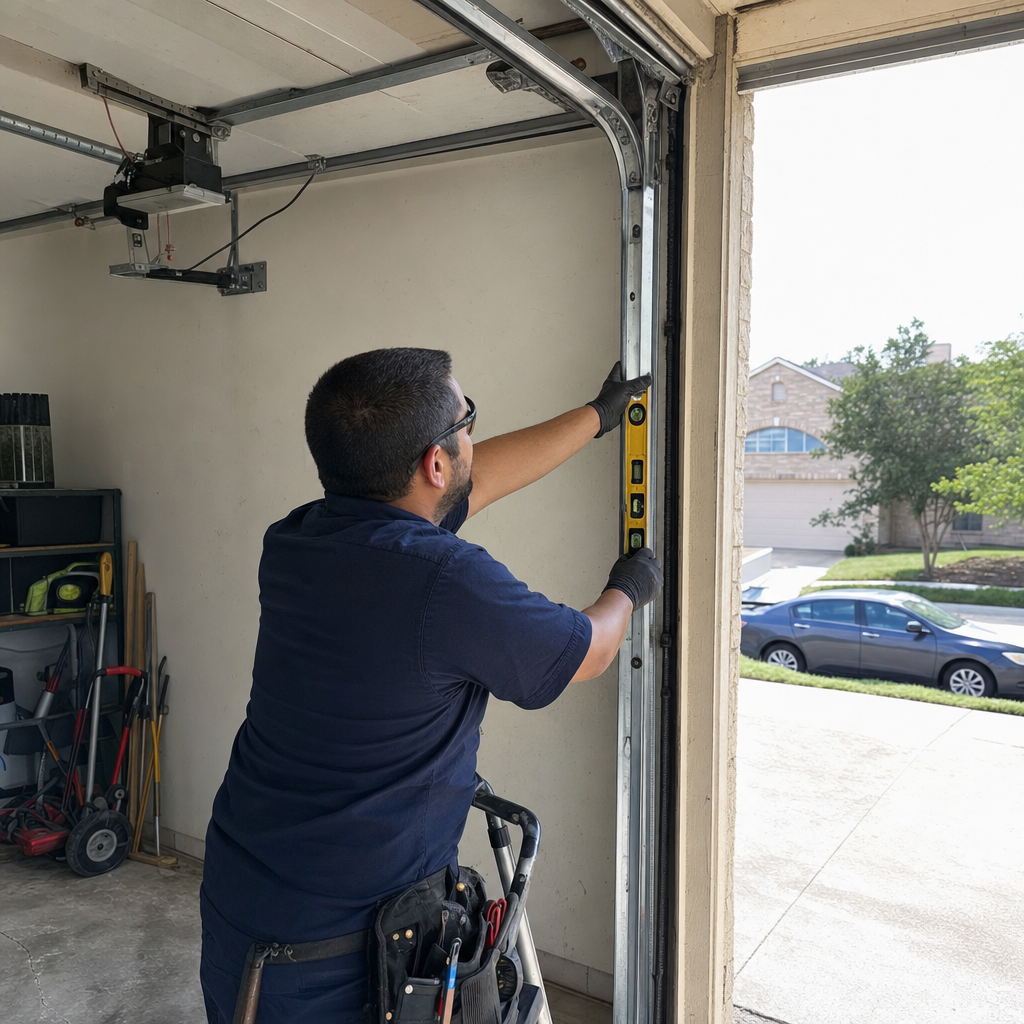
Check track alignment by looking down the length of each vertical track. The track should be plumb and parallel to the door edge with a consistent 1/4-inch gap. Gaps that vary, tracks that bow outward, or loose lag bolts at the wall bracket mounts are all issues that cause binding and premature roller wear.
How to Test Your Auto-Reverse Safety System
The auto-reverse system is the most important safety feature on your garage door opener, and it’s the check that most San Antonio homeowners skip entirely. Texas heat warps the sensitivity calibration on this system — and a door that passed its factory test will fail a real-world obstacle test after two or three San Antonio summers without adjustment.
There are two separate functions to test: the mechanical auto-reverse and the photoelectric sensor reverse.
Mechanical Auto-Reverse Test (Force Reversal)
- Place a 2×4 piece of lumber flat on the garage floor, centered under the door.
- Press the wall button or remote to close the door.
- When the door contacts the 2×4, it should immediately reverse direction and travel back to the fully open position.
- If the door hesitates, stalls on the board, or continues to push down before reversing, the force sensitivity is set too high. On a LiftMaster or Chamberlain opener, there are down-force adjustment screws on the back or side of the motor unit (usually labeled with a down arrow). Turn the down-force screw counterclockwise in small increments (1/4 turn at a time) and retest.
- Repeat until the door reverses cleanly on contact with the 2×4.
Heat causes the door and hardware to expand, which increases the effective resistance the opener senses — it can interpret this as normal friction and suppress the reverse. That’s why this test matters more in a San Antonio summer than anywhere with milder summers.
Photoelectric Sensor Test
- With the door open, wave your leg through the sensor beam (the small units mounted 4–6 inches off the floor on each side of the door frame) while pressing close.
- The door should immediately stop and reverse.
- If the door continues closing, check that both sensor units are aligned (the sending unit’s LED should be solid, not blinking), clean the sensor lenses with a dry cloth, and re-run the test.
- If realignment and cleaning don’t fix it, the sensors likely need replacement — a straightforward repair for any of the major opener brands including Genie, Craftsman, and LiftMaster.
Bottom Seal and Weatherstripping in a San Antonio Heat Cycle
The bottom seal on a San Antonio garage door takes more punishment than almost any other component. It sits on hot concrete, gets baked from above by radiant heat off the door panel, and cycles through wet-dry-wet patterns every time we get one of those summer afternoon thunderstorms followed by three weeks of 98°F dry heat.
Most bottom seals are made from EPDM rubber or vinyl. EPDM holds up better in heat but becomes brittle faster under UV exposure. Vinyl is more flexible in mild temps but softens and deforms in sustained heat. In San Antonio, we consistently see vinyl bottom seals on Raynor and mid-range Clopay doors fail within 3–4 years of installation, while EPDM seals on the same door type last 6–8 years.
What to Look For
- Cracking or splitting along the length of the seal — even small cracks let in moisture, insects, and the fine caliche dust that’s endemic to San Antonio’s soil composition.
- A gap of more than 1/4 inch between the seal and the floor when the door is fully closed — this is the threshold where scorpions, roaches, and blowing dust get through consistently.
- Compression set — the seal looks flat and no longer springs back when you lift the door. A seal in compression set has lost its sealing function even if it looks intact.
- Detachment from the door’s retainer channel — the seal should snap firmly into the aluminum or galvanized channel at the door’s base. A loose seal drags on the concrete and wears unevenly.
For the side and top weatherstripping, check for the same cracking patterns and confirm the stripping makes full contact with the door stop when closed. The north-facing garage sides in older Alamo Heights and Terrell Hills homes often show premature weatherstrip failure from moisture trapping in shaded conditions — the opposite problem from the sun-exposed south-facing units, but equally damaging to the seal material over time.
The Checklist Items Nobody Talks About: Wasps, Rodents, and Low-Voltage Wiring
This section doesn’t appear on any national garage door maintenance guide we’ve ever seen, but in San Antonio it belongs on every checklist. The city’s climate and geography create two pest-related failure modes that are genuinely common and genuinely preventable.
Wasp Nests in Track Brackets
Paper wasps — specifically the Texas species Polistes exclamans — build nests inside the horizontal track sections and in the corner bracket assemblies where the vertical and horizontal tracks meet. A mature nest inside the horizontal track creates enough physical obstruction to bind the rollers, throwing the door off-track. We’ve pulled nests out of the track brackets of Amarr and Wayne Dalton doors in neighborhoods from Helotes to Schertz, usually discovered only after a homeowner calls about a door that “just stopped working.”
Check in March and again in August — these are the two peak nesting periods for paper wasps in Bexar County. Shine a flashlight the full length of both horizontal track sections and look into the corner bracket cavities. A small nest can be knocked down and treated with a wasp freeze spray. Larger, established nests should be handled by a pest professional before you do any garage door work in that area.
Rodent Damage to Opener Wiring
Roof rats and Norway rats are year-round residents in San Antonio’s older neighborhoods — particularly in established areas like Beacon Hill, Highland Hills, and around the San Antonio River corridors. Both species chew low-voltage wiring, and the 18-22 AWG wiring that runs from your wall button to your opener motor unit and from the opener to the safety sensors is exactly the gauge they target. We’ve diagnosed multiple Chamberlain and LiftMaster opener failures in San Antonio that weren’t opener failures at all — they were severed wall-button wires chewed through above the drywall line.
During your annual hardware inspection, trace the wall-button wire from the button down to the opener and look for gnaw marks, bare copper, or sections of wire that have been chewed through and twisted back together by a previous occupant or technician. If you see evidence of rodent activity in the garage — droppings, grease marks along baseboards — treat the pest issue first and then do a full wiring audit.
Opener Health Check: LiftMaster, Genie, Chamberlain, and Beyond
Your opener works harder in San Antonio than it would in a milder climate. The combination of door hardware that runs stiffer in summer heat, heavier insulated doors that are increasingly common in new construction across the 78249 and 78254 zip codes, and the thermal expansion of the door panel itself all add load to the opener motor on every cycle.
Opener Inspection Points
- Listen for grinding or straining sounds during the open and close cycle. A healthy opener should run at a consistent speed and volume. Grinding from the drive system (chain, belt, or screw drive) often indicates a dry drive rail that needs lubrication — use a silicone spray on belt drives and a chain lube on chain drive models.
- Check the drive rail fasteners where the rail brackets attach to the ceiling joists. Heat cycles cause wood to expand and contract, and lag bolts that were tight at installation can work loose over two or three San Antonio summers. A loose rail causes the carriage to bind and adds load to the motor.
- Test the manual release (the red cord hanging from the carriage). Pull it to confirm the door disconnects from the drive and can be lifted manually. The door should balance at approximately waist height when released — if it falls or flies up, the spring balance is off and needs professional adjustment.
- Check the battery backup on LiftMaster 8500W, 87504, and similar models that include one. San Antonio’s summer thunderstorm season brings frequent brief power outages — a dead backup battery means a car trapped in the garage during a storm.
- Verify remote and keypad function from multiple distances. Intermittent signal issues in openers over 8 years old often indicate a failing logic board, not an antenna or remote issue — especially relevant for older Craftsman and Genie units installed in the early-to-mid 2010s.
If you’re due for a new opener, we can service or install any of the major brands — including LiftMaster, Chamberlain, Genie, Craftsman, and others — and match the right unit to your door’s weight and size. For homeowners in Balcones Heights specifically, our Garage Door Opener in Balcones Heights page covers what to expect from a new opener installation in that area.
Month-by-Month Maintenance Schedule for San Antonio
This schedule is built around San Antonio’s actual climate patterns, not a generic four-season template. The two events that drive this calendar are the arrival of serious heat in late May and the end of the storm season in October.
| Month | Task | Why Now |
|---|---|---|
| February | Full hardware visual inspection; check bottom seal condition after winter | Catch anything that degraded over the dry winter period before heat arrives |
| March | First wasp nest inspection; check track bracket cavities | Peak early nesting season for paper wasps in Bexar County |
| April | Full lubrication cycle (springs, hinges, rollers, drive rail); auto-reverse test | Pre-summer lubrication before temperatures start consistently exceeding 90°F |
| May | Check opener drive rail fasteners; test battery backup | Storm season begins — power outages and vibration from wind increase |
| July | Mid-summer spot check: re-lubricate springs and hinges; check cable drums | Peak heat has been running for 6+ weeks; lubricant has likely thinned and migrated |
| August | Second wasp nest inspection; rodent wiring check; sensor lens cleaning | Late summer peak for both paper wasp nesting and rodent activity inside garages |
| October | Post-storm-season full inspection: cables, springs, track alignment, weatherstripping | Cumulative storm-season stress shows up now; catch failures before the holiday season |
| December | Third lubrication cycle; test manual release; verify remote function | Pre-winter preparation; also catches any issues before holiday travel periods |
Common Mistakes to Avoid
- Using WD-40 on garage door springs. WD-40 is a solvent-based product, not a long-term lubricant. In San Antonio’s heat, it evaporates within days and leaves springs drier than before. Use a silicone spray or high-temp lithium grease rated specifically for garage door hardware.
- Lubricating the inside face of the tracks. This is one of the most common DIY mistakes we see in San Antonio homes. Greasy tracks collect the fine caliche and limestone dust that’s endemic to this area’s soil — within a few weeks you have an abrasive paste grinding against your rollers on every cycle.
- Ignoring a single broken cable strand. A lift cable showing even two or three broken individual strands is already structurally compromised. Cable failure under load is sudden and complete — there’s no gradual warning. In San Antonio’s humidity, a partially frayed cable can go from “showing wear” to “snapped” faster than in drier climates.
- Adjusting torsion spring tension without training. We understand the appeal of fixing it yourself — but a torsion spring under working tension stores enough force to cause severe injury if the winding bar slips. This is not a risk worth taking. Call a technician for any spring work.
- Skipping the auto-reverse test because the door “seems fine.” Heat changes the calibration of the force-reversal system on every opener brand — LiftMaster, Chamberlain, Genie, all of them. A door that closes on a child or a pet because the reversal threshold drifted up in the summer heat is an entirely preventable tragedy.
- Replacing a broken spring with only one spring on a two-spring system. Both springs in a dual-spring system age together. Replacing only the broken one means the surviving spring — already at the end of its fatigue life — will likely fail within 3–6 months. Replace both at the same time.
- Overlooking pest activity in the garage. A garage in Stone Oak or Helotes that shows rodent droppings or wasp activity near the tracks needs a pest and wiring inspection before any other maintenance work proceeds. Fixing the mechanical issue without addressing the underlying pest problem means the same failure recurs.
When to Call a Professional
Routine tasks — lubrication, visual inspection, sensor testing, seal replacement — are DIY-appropriate for most homeowners. But some situations need a trained technician, and recognizing them early saves money and prevents injury.
Call a professional immediately if:
- A torsion spring has a visible gap in the coils (it’s broken and the door should not be operated).
- A lift cable is frayed, kinked, or has snapped off the bottom bracket.
- The door is off-track — running at an angle or binding in the tracks on one side.
- The opener runs but the door doesn’t move, or moves only a few inches before reversing.
- The door falls faster than normal when you disconnect the opener and lift it by hand.
- You hear a loud bang from the garage — this is the sound of a torsion spring breaking under tension.
Express Gate Repair Services San Antonio offers free estimates and emergency availability for situations that can’t wait. Kevin Lopez handles the diagnosis and the repair himself — you get 16 years of hands-on experience on every call, not a subcontractor reading from a checklist. Call (830) 521-5767 any time you’re not sure whether what you’re seeing is a DIY fix or a professional job. A two-minute phone call is always worth it.
Frequently Asked Questions
How often should I lubricate my garage door in San Antonio?
In San Antonio, lubricate your garage door springs, hinges, and rollers every four months — not once a year as most national guides suggest. The combination of extreme summer heat and humidity accelerates lubricant breakdown significantly faster than in cooler climates. A practical schedule is April (pre-summer), late July or August (mid-summer check), and December (pre-winter). If your garage faces south or west and gets direct afternoon sun, consider every three months for springs specifically. Call (830) 521-5767 if you’d like Kevin to walk you through the right products for your door’s brand and hardware type.
What kind of lubricant should I use on garage door springs in Texas heat?
Use a silicone-based garage door lubricant or a high-temp lithium grease with a dropping point above 300°F. Standard WD-40 and general-purpose 3-in-1 oils are not appropriate — they evaporate quickly in San Antonio’s summer temperatures and leave springs dry within days. Products marketed specifically as “garage door lubricant” are formulated to stay on metal at elevated temperatures. Avoid anything petroleum-based with a low viscosity rating on the label.
How do I test the auto-reverse on my garage door opener?
Place a 2×4 flat on the floor under the center of the door and press close. The door must reverse immediately upon contacting the board — if it hesitates or pushes down before reversing, the down-force setting is too high and needs adjustment. Also test the photoelectric sensors by waving your leg through the beam while the door is closing — the door should stop and reverse instantly. Run both tests every six months in San Antonio, as summer heat regularly shifts the force calibration on all major opener brands including LiftMaster, Chamberlain, and Genie.
Why does my garage door bottom seal keep cracking and failing?
San Antonio’s heat-and-drought cycle followed by heavy rain events causes rubber and vinyl seals to expand, contract, and UV-degrade faster than in most U.S. markets. Vinyl seals typically last 3–4 years here; EPDM rubber seals last 6–8 years under normal conditions. If you’re replacing a failed seal, choose EPDM over vinyl for better heat and UV resistance, and consider a heavier-gauge seal if your driveway has any slope that creates an uneven contact line.
Can wasps actually damage my garage door?
Yes — paper wasp nests built inside horizontal track sections or corner bracket assemblies can physically obstruct the rollers, throwing the door off-track. In San Antonio, paper wasps are active from March through late October, with peak nesting in March and again in August. Inspect the full length of your horizontal tracks and all bracket cavities during those two windows each year. A small nest can be treated with wasp freeze spray; a large established nest should be handled by a pest professional before you work around it.
Is it worth repairing a 15-year-old garage door, or should I replace it?
A 15-year-old door in San Antonio that has been maintained reasonably well — functioning panels, intact weatherstripping, good hardware condition — is usually worth repairing if the issue is springs, cables, rollers, or opener. Those components are replaceable on virtually any brand, including Clopay, Amarr, Wayne Dalton, and Raynor. If the door panels are cracked, dented beyond cosmetic repair, or the door is an older single-layer design that’s driving up your energy bill, a new installation often makes more financial sense over a 5-year horizon. Our Garage Door Installation in Balcones Heights page gives a clear picture of what a replacement project involves. Call (830) 521-5767 for a free assessment — Kevin can tell you within minutes whether repair or replace is the right call for your specific door.
The Bottom Line
A garage door in San Antonio faces conditions that genuinely shorten the service life of springs, cables, seals, and lubricants compared to most of the country. The maintenance checklist that matters here is built around a four-month lubrication cycle, climate-appropriate products, pre-summer and post-storm-season inspection timing, and checklist items — wasp nest checks, wiring audits — that no national guide will ever include. Stay ahead of the schedule outlined here, run your auto-reverse test every six months, and replace worn components before they fail under load. For anything involving springs, cables, or a door that won’t move safely, call Express Gate Repair Services San Antonio at (830) 521-5767 for a free estimate. Kevin Lopez will diagnose it himself — no guesswork, no subcontractors, no upsells you don’t need. For homeowners in the northwest corridor, our Garage Door Repair in Balcones Heights page covers the specific services available in that area.
Written by Kevin Lopez, Owner & Lead Technician at Express Gate Repair Services San Antonio, serving San Antonio since 2010.