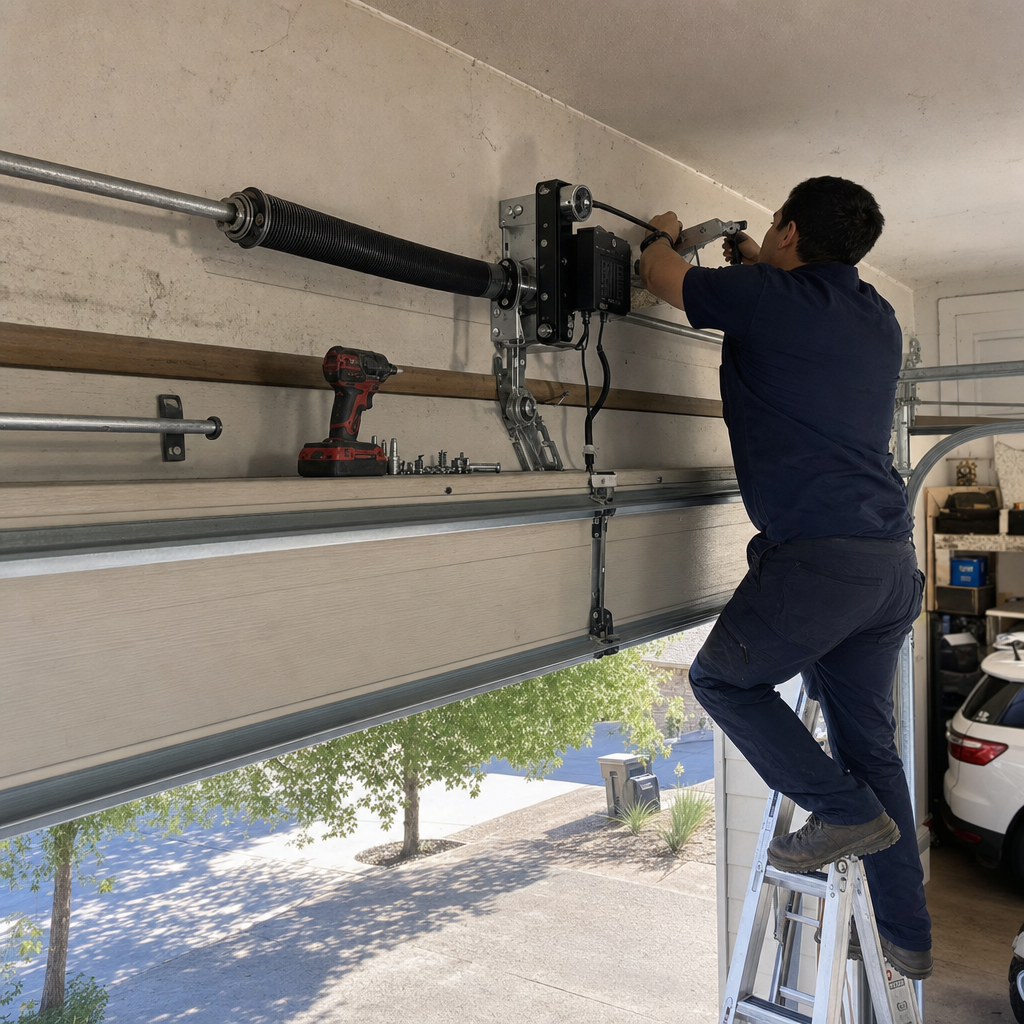
Last updated June 21, 2026
Seasonal Garage Door Care for San Antonio: Year-Round Homeowner’s Guide
February in San Antonio can hit 80°F one week and drop to 19°F the next — the 2021 freeze proved that overnight, and garage doors with dried-out bottom seals and under-lubricated torsion springs failed by the thousands across the city in a single 72-hour window. Most of those failures weren’t random bad luck; they were the predictable result of skipping maintenance steps that only matter in San Antonio’s specific climate. This guide walks you through exactly what to do — and when — to keep your garage door running through the heat surges, cold snaps, hail events, and humidity swings that define life here. What you’ll learn isn’t generic advice; it’s calibrated to San Antonio’s actual weather patterns, not some national template written for Boston or Denver.
Quick Answer
San Antonio’s climate doesn’t follow a standard four-season pattern, so the typical “spring and fall maintenance” advice doesn’t apply. The most important windows are April (pre-summer prep before sustained heat above 95°F), late October through November (freeze-proofing before cold snaps), and immediately after any severe hail or wind event. Keeping springs lubricated, bottom seals flexible, and your manual disconnect tested covers roughly 80% of the failure modes we see year after year in San Antonio.
Table of Contents
- Why San Antonio’s Climate Breaks the Standard Maintenance Calendar
- April Pre-Summer Prep: Protecting Springs, Cables, and Opener Boards Before the Heat Hits
- Summer Stress Management: What 95°F+ Does to Every Moving Part
- Freeze-Proofing for San Antonio’s Irregular Cold Snaps
- Post-Storm Inspection After Hail and Wind Events
- The September–October Humidity Drop and Wood Composite Doors
- The One Annual Task Most Homeowners Skip: Testing the Manual Disconnect
- Common Mistakes to Avoid
Why San Antonio’s Climate Breaks the Standard Maintenance Calendar
The standard home maintenance advice — “service your garage door in spring and fall” — was written for climates with predictable seasonal transitions. San Antonio doesn’t have those. What it has are two violent weather pivots: the March humidity surge that turns cold, dry winter air into warm, moisture-heavy air almost overnight, and the September heat break that sends temperatures swinging 30 degrees in a week. Bookending those transitions is a summer that regularly runs four to five months of 95°F-plus temperatures — longer than almost anywhere else in Texas.
That heat duration is the real threat to garage door hardware. Metal expands under heat, springs lose tension incrementally over thousands of cycles in high temperatures, and the circuit boards inside LiftMaster and Chamberlain openers weren’t designed to cook inside a West Side or Stone Oak garage that routinely reaches 130°F in August. Meanwhile, the Bexar County area’s sporadic but severe winter cold snaps — like the one in February 2021 that caught most homeowners completely unprepared — expose every deferred lubrication job and every cracked bottom seal in one merciless event.
The right maintenance schedule for San Antonio has three core checkpoints: April, late October, and after any severe storm. Everything else is monitoring. Build your year around those three windows and you’ll prevent the vast majority of costly breakdowns.
April Pre-Summer Prep: Protecting Springs, Cables, and Opener Boards Before the Heat Hits
April is your single most important maintenance window. By the time May arrives, San Antonio temperatures are already climbing past 90°F with regularity, and the damage to under-serviced hardware compounds fast. Here’s the exact sequence we recommend — and the specific products that hold up in this climate:
- Lubricate torsion springs with white lithium grease — not WD-40, which evaporates and actually attracts grit. We use 3-IN-ONE Professional Garage Door Lube or Blaster Garage Door Lubricant specifically because both contain silicone carriers that resist the heat-driven evaporation that strips petroleum-based products off metal within weeks in a San Antonio summer. Apply to the coils of both torsion springs, working the door through three full open-close cycles to distribute the lubricant evenly.
- Lubricate rollers, hinges, and the bearing plates at both ends of the torsion bar. Nylon rollers don’t need lubrication on the wheel itself — only on the stem. Steel rollers need it on both.
- Inspect and lubricate cables where they wrap around the cable drums. Look for fraying or kinking. A cable showing more than two or three broken strands is past its safe service life — replace it before summer cycling puts it under maximum stress daily.
- Check opener ventilation. Most LiftMaster, Genie, and Chamberlain units mount near the ceiling, exactly where garage heat pools. Make sure the motor housing isn’t blocked by stored items and the unit isn’t in direct contact with insulation that traps heat. Some homeowners in the Alamo Ranch and Leon Valley areas add a small battery-backed ventilation fan to the garage ceiling — it’s a meaningful extension of opener lifespan.
- Test the auto-reverse safety feature. Place a 2×4 flat on the ground in the door’s path. The door should reverse immediately on contact. High heat can affect the sensitivity calibration on older units.
- Inspect weather stripping on all four sides — top, sides, and bottom seal. Cracked or stiff stripping is both an energy problem and a water intrusion risk ahead of San Antonio’s summer storm season.
Summer Stress Management: What 95°F+ Does to Every Moving Part
Once San Antonio’s summer is running — roughly late May through September — the maintenance goal shifts from preparation to monitoring. There’s less you can do proactively and more to watch for. The failure modes we see most often during peak summer include:
- Spring tension drift: Torsion springs cycle tens of thousands of times over their lifespan, and heat accelerates metal fatigue. A spring that breaks in July didn’t fail suddenly — it was stressed incrementally all summer. If your door feels heavier when lifting manually or the opener seems to strain more than usual, the spring tension may need adjustment.
- Opener motor overheating: LiftMaster’s higher-end units (the 87504-267, 84501, and similar) have built-in thermal overload protection that shuts the unit down temporarily. If your opener stops responding on a 105°F afternoon and works fine the next morning, overheating is the likely culprit — not a mechanical failure. Add ventilation before assuming you need a new unit.
- Track expansion causing binding: Steel tracks expand in heat. If your door runs smoothly in the morning and drags or skips in the afternoon, thermal expansion of the vertical tracks may be the cause, particularly in doors over 10 years old where the track hardware has loosened.
- Seal adhesion failure: The top and side weatherstripping on older Clopay, Amarr, and Wayne Dalton doors can soften and detach from the door jamb in prolonged heat. Check adhesion monthly during summer and re-secure with exterior-rated adhesive if needed.
During summer months, run a quick 30-second visual inspection every two to three weeks. Look for anything that looks or sounds different — new grinding, new hesitation, new gaps in the weatherstripping. Catching changes early means a simple adjustment rather than an emergency call.
Freeze-Proofing for San Antonio’s Irregular Cold Snaps
San Antonio’s cold snaps are dangerous precisely because they’re rare enough that homeowners don’t stay prepared for them. The 2021 freeze event dropped temperatures to single digits in areas like the South Side and Schertz corridor, and garage doors were among the most common household failures reported — not because San Antonio doors are poorly made, but because maintenance had lapsed under the assumption that severe cold was unlikely.
Here’s what to do before cold weather arrives — and what to do if you wake up to a frozen door:
Pre-Freeze Checklist (Late October Through November)
- Test bottom seal flexibility. Grab the bottom seal and bend it with your hand. If it cracks or shows white stress marks, it’s already too stiff to seal against a cold concrete floor — replace it before the first freeze. A seal that’s rigid above 50°F will be completely inflexible at 20°F and will gap, letting cold air and moisture underneath.
- Re-lubricate springs with a cold-weather-appropriate lubricant. Torsion springs snap at dramatically higher rates below 20°F because cold metal becomes brittle and the lubricant film that reduces friction has dried off. Switch to a silicone-based spray (not petroleum grease, which thickens in cold) in late October.
- Check the threshold seal on the garage floor where the bottom of the door meets the concrete. Gaps here allow cold air to pool at floor level, which freezes any moisture and can bond the door to the floor by morning.
- Know your manual release cord location (see the full section below).
If Your Door is Already Frozen Shut
- Do not force the opener to overpower the frozen door — this is how openers burn out and how cables snap.
- Use a heat gun or hair dryer on low heat along the bottom seal where it meets the concrete. Work slowly across the full width.
- Once the seal breaks free, manually lift the door a few inches before engaging the opener.
- If the door still won’t move after the ice is clear, the springs may have lost tension in the cold. This is a professional repair — call rather than force it.
Post-Storm Inspection After San Antonio’s Hail and Wind Events
San Antonio sits in a hail corridor that produces large-stone events several times a year — the Helotes, Stone Oak, and Converse areas have each taken significant garage door panel damage in recent seasons. After any hail event above 3/4-inch stone size, or any wind event with sustained gusts above 50 mph, do a structured inspection before assuming the door is fine.
What to Inspect and What You’re Looking For
- Panels: Look for dents, creases, and — critically — cracks in the panel face. A dent on a steel door is cosmetic. A crease that runs across a panel horizontally is a structural fracture that will worsen over time and eventually prevent the door from sealing. Clopay and Amarr steel panels hold up better to hail impact than thinner-gauge doors; Wayne Dalton’s lighter residential lines are more susceptible.
- Tracks: Walk the full length of both vertical tracks and look for bends, bulges, or sections that have pulled away from the wall. A track that looks slightly bowed isn’t always obvious in casual inspection — run your eye down the full length at track height.
- Weatherstripping on all four sides: Hail impact and high wind can tear the top and side seals away from the door jamb or tear the vinyl itself. Water intrusion through damaged stripping causes more damage over time than the initial hail hit.
- The track brackets and wall anchors: High wind loading can loosen the lag screws that anchor the horizontal tracks to the ceiling. Check for any movement when you pull on the horizontal track section by hand.
- Opener antenna wire: The antenna that hangs from most LiftMaster and Chamberlain units can be knocked loose or shorted by water intrusion through a damaged top seal. If your remote range drops after a storm, check the antenna before assuming the remote needs new batteries.
The September–October Humidity Drop and Wood Composite Doors
San Antonio’s September and October bring a rapid humidity drop as the Gulf moisture patterns shift. For most homeowners this is welcome relief from the summer swelter. For homeowners with wood composite garage doors — a popular choice in older neighborhoods like Monte Vista, Alamo Heights, and King William — it’s the beginning of a cycle that reveals whether any summer moisture damage is cosmetic or structural.
Here’s what happens: wood composite panels absorb moisture from San Antonio’s humid summer air and expand slightly. As humidity drops sharply in September, that moisture leaves quickly. If the door’s factory finish or field-applied paint has any cracks, chips, or gaps, moisture enters during the wet period and exits as vapor during the dry period — and carries wood fibers with it. Over several cycles, the panel begins to delaminate from the inside out.
How to Read the Swelling Patterns
- Cosmetic damage: Surface paint peeling or minor swelling at panel edges that closes up as humidity drops. This is repairable with sanding, primer, and exterior-grade paint applied before the next humid season.
- Structural damage: Panel sections that remain bowed or swollen after humidity normalizes (typically by late October), or sections where the composite layers are visibly separating at the edges. Once delamination begins, the structural integrity of the panel is compromised — no amount of paint will reverse it. Replacement is the right call.
- Check the bottom rail of each section specifically, as it’s the lowest point and collects the most moisture. On a Clopay or Raynor wood composite door, a bottom rail that feels soft or spongy when you press on it has likely experienced moisture infiltration into the core material.
The September-October window is the right time to apply a fresh coat of exterior-grade primer and paint to any wood composite door, sealing the surface before the next moisture cycle begins in spring.
The One Annual Task Most Homeowners Skip: Testing the Manual Disconnect
Every residential garage door opener — LiftMaster, Genie, Chamberlain, Craftsman, Raynor, all of them — has a red manual disconnect cord hanging from the trolley carriage. Pulling it disengages the door from the opener drive and lets you operate the door by hand. Most homeowners have never pulled it. In San Antonio, where severe storms, power outages from summer thunderstorms, and the occasional deep freeze can leave homes without power for days, that cord is genuinely important.
Here’s the problem: the disconnect mechanism can seize up from disuse, particularly in garages that run hot for months at a time. If you’ve never pulled the cord, you don’t know whether it actually works — and you definitely don’t want to find out for the first time when the power is out, it’s dark, and your car is trapped inside.
How to Test It Correctly (Once Per Year, Ideally in April)
- Close the garage door fully before testing. A door that’s open and disconnected from the opener can free-fall if the spring tension is off.
- Pull the red cord firmly toward the back of the garage. You should feel a click as the carriage disengages from the drive rail.
- Lift the door manually. It should move smoothly with moderate effort. If it feels extremely heavy, the spring balance is off — that’s a separate issue to address, but now you know before an emergency.
- Re-engage the trolley by pulling the red cord back toward the door (on most LiftMaster and Chamberlain units) or by simply running the opener once (on Genie and some Craftsman models — the trolley re-engages automatically on the first powered cycle).
- Confirm the opener re-engaged by running a full open-close cycle.
This 90-second test once a year has saved more than a few of our customers from being completely stuck during San Antonio’s summer storm blackouts. It’s not boilerplate safety advice — in a city that gets 50+ storm events annually, it’s a practical skill.
Common Mistakes to Avoid
- Using WD-40 on torsion springs. WD-40 is a solvent and water displacer, not a durable lubricant. It strips away existing lubrication, evaporates quickly in San Antonio’s heat, and leaves springs drier than before. Use a dedicated garage door lubricant with a silicone or lithium base.
- Ignoring a door that “just sounds a little louder.” Grinding, squealing, or clunking that wasn’t there last month is the door telling you something has changed — a roller is failing, a hinge is binding, or a cable is fraying. In our experience, the customers who wait six months on a new noise end up with a bigger repair bill than those who address it immediately.
- Forcing a door open during a freeze. Running the opener against a door frozen to the floor can burn out the motor or snap a cable. The cost of patience — two minutes with a hair dryer — is dramatically lower than an emergency opener replacement call.
- Painting over weatherstripping adhesion problems instead of resealing. Several homeowners in the Alamo Heights and Terrell Hills areas have called us after DIY paint jobs that sealed peeling weatherstripping back to the door jamb temporarily. Paint is not a sealing agent — the stripping will fail again with the first temperature swing, and the moisture intrusion problem that caused the peeling is still active underneath.
- Skipping the post-hail inspection because the door still opens. A door that opens after a hail event isn’t necessarily undamaged. Panel fractures, bent tracks, and loosened hardware can operate for weeks before causing a failure — and the repair is almost always worse (and more expensive) after the deferred damage compounds.
- Adjusting the limit switches or spring tension without experience. The spring on a standard residential torsion system holds several hundred foot-pounds of stored energy. Adjusting it without knowing what you’re doing is dangerous regardless of how many tutorial videos you’ve watched. Spring adjustment and replacement is one of the few garage door tasks where calling a professional isn’t optional — it’s just the right call.
- Assuming a San Antonio garage door install doesn’t need manufacturer-specific service. Each brand — Clopay, Amarr, Wayne Dalton, Raynor — has proprietary hardware profiles, spring wind configurations, and track systems. Generic service on a brand-specific door often means mismatched parts or incorrect tension settings. Work with someone who knows the specific brand on your home. For professional service on all of those brands, Express Gate Repair Services San Antonio home is the right starting point.
When to Call a Professional
Some garage door tasks are genuinely homeowner-friendly: lubricating springs and rollers, replacing weatherstripping, testing the manual disconnect, tightening loose hardware. Others aren’t — and the line between them is usually defined by stored energy or electrical systems.
Call a professional when you’re dealing with any of the following:
- A broken torsion or extension spring — these hold dangerous levels of stored tension and must be replaced with the correct spring specification for your door’s weight and height.
- A snapped or frayed cable.
- A door that has come off its tracks entirely.
- An opener that sparks, smells like burning, or trips your circuit breaker.
- Any post-hail inspection that reveals bent tracks or panel fractures you’re not sure how to evaluate.
- A wood composite door with soft or delaminating panel sections.
Express Gate Repair Services San Antonio offers free estimates across San Antonio — and Kevin Lopez handles the diagnosis himself, not a subcontractor. Whether you need a Garage Door Repair in Balcones Heights or emergency service after a storm, call (830) 521-5767 and get a straight answer from someone who’s seen the problem before.
Frequently Asked Questions
Lubricate your torsion springs every six months at minimum — April and October are the right windows for San Antonio’s climate. If your garage runs particularly hot in summer (above 100°F interior temperatures), or if the door runs multiple cycles per day, quarterly lubrication with a silicone or lithium-based spray is better. Use 3-IN-ONE Professional Garage Door Lube or Blaster Garage Door Lubricant — both hold up in high-heat conditions far better than petroleum-based products. Call (830) 521-5767 for a free assessment if you’re unsure about your springs’ current condition.
The most common failure modes during the February 2021 event were frozen bottom seals bonding to concrete floors (preventing the door from opening), torsion spring snaps caused by brittle metal below 20°F, and opener motors burning out from homeowners forcing frozen doors. All three failure modes are preventable with fall maintenance — flexible bottom seals, cold-weather lubricant on springs, and knowing how to manually release the door before applying opener power. If your door never fully recovered from the 2021 freeze, there may be underlying hardware damage still affecting performance.
Dents without creases are cosmetic on steel doors — they don’t affect function or integrity. A horizontal crease running across a panel is structural; it weakens the panel’s cross-section and will worsen with normal cycling. On wood composite doors, soft or spongy areas after hail indicate moisture infiltration — probe the affected section with your finger. Any door where a panel section has shifted position relative to its neighbors has likely taken a hit that affected the internal panel framing. When in doubt after a significant San Antonio hail event, a professional inspection takes about 20 minutes and prevents months of deferred damage.
Bottom seal and side stripping replacements are reasonable DIY tasks for a homeowner comfortable with basic tools. The bottom seal on most residential doors slides into a T-slot channel — no fasteners required — and replacements are available at hardware stores in San Antonio. Side and top weatherstripping typically uses a compression seal stapled or nailed to the door jamb. Where DIY gets complicated is when the door stop (the wood trim the stripping mounts to) has rotted or warped, which requires carpentry work before the new stripping will seal correctly.
Standard residential torsion springs are rated for approximately 10,000 cycles — roughly 7 to 10 years at average usage. In San Antonio’s climate, heat-accelerated metal fatigue and the lack of consistent lubrication (which most homeowners skip) can shorten that lifespan to five to seven years. If your springs are original to a door installed before 2018, they’re worth inspecting this spring. A spring that breaks without warning drops the full door weight onto the opener — that secondary failure is usually more expensive than the spring replacement itself.
Steel doors aren’t immune to humidity damage, but the mechanism is different. The real risk with steel doors in San Antonio is rust at the bottom panel section where the door contacts the floor — particularly on doors without a galvanized bottom rail or on doors where the bottom rail paint has been chipped. San Antonio’s late-spring humidity combined with concrete moisture can accelerate rust formation at the door’s lowest point. Inspect the bottom rail every spring and touch up any bare metal with a rust-inhibiting primer before it spreads to the panel face. Brands like Clopay and Amarr use heavier galvanized bottom rails than some entry-level alternatives, which holds up better over time in this climate. If you’re considering an upgrade, explore Garage Door Installation in Balcones Heights to see what options are available for the San Antonio market.
The Bottom Line
San Antonio’s garage doors face a maintenance challenge that most national guides don’t account for: brutal summer heat followed by irregular but severe cold snaps, with heavy storm seasons bookending both transitions. The homeowners who avoid expensive breakdowns aren’t doing more maintenance — they’re doing the right maintenance at the right three windows: April pre-summer prep, late October freeze-proofing, and post-storm inspection after every significant hail or wind event. Keep springs lubricated with the right product, test your manual disconnect once a year, and don’t ignore new noises. Those three habits cover the majority of what Kevin Lopez sees on service calls across San Antonio — problems that could have been caught weeks or months earlier with five minutes of attention.
For opener service, parts, or anything beyond basic lubrication, see Garage Door Opener in Balcones Heights for the full scope of opener services available in the area.
When you’re ready for a professional set of eyes on your door, call (830) 521-5767 for a free estimate. Kevin Lopez takes the call, handles the diagnosis, and does the work — 16 years of experience on your specific door, not a rotating crew with a clipboard.
Written by Kevin Lopez, Owner & Lead Technician at Express Gate Repair Services San Antonio, serving San Antonio since 2010.